Showing posts with label script. Show all posts

January 30, 2018

Blind Date

We use FDQM to pull data from our various ERP systems into HFM.  Whenever possible we use import scripts to pull data directly from the ERP system or an intermediary SQL datamart rather than from flat files.  In addition to integration scripts that do a complete pull of the data from an external source, FDQM can use data pump scripts which provide a way to customize processing just one field when importing a file.

FDQM scripting uses vbScript so scripting features like file access are available as well as ADODB to make database connections and queries.  FDQM also provides its own API libraries to access native features such as the current POV.  These are available via the objects API (application programming interface), DW (Data Window for database access) and RES (FDQM resources).  These can all be seen in the Object Browser in FDM Workbench.


In our source systems the data is stored with fields that identify the period and year.  The RES.PstrPer object returns the period currently selected in FDQM. This is the value in the Text Description field in the Control Table for Periods


To access the period and year we take appropriate substrings of the RES.PstrPer value.

Dim StrPer 'Uses the Date POV to find the current period
Dim StrYr 'Uses the Date POV to find the current year
strPer = Left(RES.PstrPer,3) 'Retrieve the period from the POV
strYr  = Right(RES.PstrPer,4) 'Retrieve the year from the POV

If the periods are referenced by number instead of name there are a variety of ways to accomplish the translation.  I like finding the position of the period in the full list of periods then doing some math.

' The strAllPers contains the abbreviations of all the periods
'   Search for the position of the current period, subtract 1, divide by 4 and add 1
'   So for Jan we get ((1-1=0)/4=0)+1 = 1
'      for Feb we get ((5-1=4)/4=1)+1 = 2
'   etc.
'   for Dec we get ((45-1=44)/4=11)+1 = 12
'
Dim strPerNum ' Numeric value of period
Dim strAllPers ' All periods for use in index
strAllPers = "Jan Feb Mar Apr May Jun Jul Aug Sep Oct Nov Dec"
strPerNum = ((InStr(strAllPers,strPer)-1)/4)+1

Problem


For one of our ERP systems we have to provide the dates for the start and end of the period to a SQL stored procedure.  The RES.PdtePerKey retrieves the end date for the period which is the Period field in the Periods Control Table as shown in the previous screen shot.  Then use the vbScript DateAdd function to calculate the start date of the period.

Dim dtePerKey ' Last date of the current POV period
dtePerKey = RES.PdtePerKey

Dim dteStart ' Start date of the current POV period
dteStart = DateAdd("d",1,DateAdd("m", -1, dtePerKey))

For Sep - 2016 we get 9/30/16 as dtePerKey.  We subtract one month to get the last day of August, then add one day to get the first day of September.  Note that the RES.PdtePerKey returns a date value, not a string, so use appropriate conversion functions as needed.

Our problem came when we converted from calendar year periods to 4-4-5 fiscal periods.  This means we can't guarantee that the period end date is the last day of the month or the period start date is the first of the month.  What's a mother to do?

First we configure the correct period end dates for our fiscal periods in the Periods control table.  Define the period end date and the prior period end date along with the target period and year.


In the Workbench Client there are a number of Accelerators.  Under the section Point-Of-View Information there is an accelerator named Get Period Prior Date Key.


Sweet.  In the FDQM Periods control table we define the correct end dates for the periods, use the accelerator to get the prior period end date, then add one day to get our period start date.  Double-clicking the accelerator adds the following code to your script.

'Declare Local Variables
Dim dtePriorPeriodKey

'Get prior period date key
dtePriorPeriodKey = API.POVMgr.fPeriodKey(API.POVMgr.PPOVPeriod, True).dteDateKey

Easy-peasy.  But when you run the script you get:

Error: An error occurred importing the file.  Detail: Object required: 'API'

Ain't that a kick in the knickers?  It turns out you can only use the calls to API objects in data pump scripts, not integration scripts.

Fortunately we have standard vbScript features available including ADODB which allows access to databases.  Any databases.  Even our FDQM database.  FDQM uses the tPOVPeriod table to store the period data.  We can use ADODB to make a connection to the FDQM database, query the tPOVPeriod table for the period in our POV, get the PriorPeriodKey value, then add one day.

The code I use which includes some error handling looks like this:

' Find the start date of the period.  We can't use the API in the import scripts
'   The tPOVPeriod table in the FDQM database has the period information which includes
'   the prior period end date.  So we make another ADODB connection to that database
'   and find the record for this period.
' Get the PriorPeriodKey field from the result set and add one day
'
Dim fdmSS    ' Connection to FDQM database
Dim fdmRs    ' Records returned from query
Set fdmSS = CreateObject("ADODB.Connection")
Set fdmRs = CreateObject("ADODB.Recordset")
fdmSS.Open "Provider=SQLOLEDB.1;Integrated Security=SSPI;Persist Security Info=False;Initial Catalog=FDQM;Data Source=MySQLServer;"

' The query should return one record
'
Dim fdmQ
fdmQ = "SELECT * FROM tPOVPeriod where PeriodDesc = '" & RES.PstrPer & "'"
fdmRS.Open fdmQ, fdmSS

' If we get no records then something is broken
'
If fdmRS.bof And fdmRS.eof Then
RES.PstrActionValue = "No Start date found"
Import_Script=False
Exit Function
Else
Dim dtePriPer  ' Prior period end date as datetime value
dtePriPer = fdmRS.Fields("PriorPeriodKey").Value
dteStart = DateAdd("d",1,dtePriPer)   ' Add 1 day to get first day of current period
End If

While I used this technique to get to the prior period date we can get any fields we want from any FDQM tables.
  • tPOVPeriod has the period control table data
  • tPOVCategory has the Categories control table data
  • tCtrlCurrency has the Currency control table data
  • tPOVPartition has the partition/location data
  • tDataMap has the mapping tables for all partitions and dimensions
  • tLogActivity has the process and error logging data
  • tSecUser lists all provisioned users and their security level
  • tSecUserPartition lists all users, their provisioned partitions, and default partition
I can't think of a good reason why you would want to get to some of this data in an import script, but it is available if you need it.  

June 11, 2017

HFM Data Audit (part 2)

In the previous post I detailed the mechanics of enabling and exporting data audits in HFM.  But what can you do with data once it's exported?

One option is to keep those .csv files for an arbitrary period of time.  If an issue arises you could search all those files for data of interest.  But you need some utility to search many files for text of interest and you could run into space issues which would require deleting deleting old data.

I prefer to import the data into a SQL database.  The data can be kept as long as needed and is easier to search.

With SQL server we can use the bcp utility to import the .csv files into a database table.  The table should match the fields we get in the .csv file.  The following is a sample create table statement to match the .csv file format.

CREATE TABLE [dbo].[AuditRecords](
[UserName]   [nvarchar](32) NULL,
[Activity]   [nvarchar](16) NULL,
[Timestamp]  [datetime] NULL,
[ServerName] [nvarchar](8) NULL,
[Scenario]   [nvarchar](16) NULL,
[Year]       [smallint] NULL,
[Period]     [nvarchar](3)  NULL,
[Entity]     [nvarchar](32) NULL,
[Value]      [nvarchar](16) NULL,
[Account]    [nvarchar](40) NULL,
[ICP]        [nvarchar](24) NULL,
[Custom1]    [nvarchar](32) NULL,
[Custom2]    [nvarchar](24) NULL,
[Custom3]    [nvarchar](8)  NULL,
[Custom4]    [nvarchar](32) NULL,
[DataValue]  [nvarchar](24) NULL
)

Now that we have a table to hold our data we need to import it.  The bcp utility uses an import format file to specify how to parse fields in the file being imported.  The specifications for the format file are kind of klunky which you can read about here.  But this is the format file I use:

10.0
16
1   SQLCHAR   0   64      ";"      1     UserName           SQL_Latin1_General_CP1_CI_AS
2   SQLCHAR   0   32      ";"      2     Activity           SQL_Latin1_General_CP1_CI_AS
3   SQLCHAR   0   24      ";"      3     Timestamp          ""
4   SQLCHAR   0   16      ";"      4     ServerName         SQL_Latin1_General_CP1_CI_AS
5   SQLCHAR   0   32      ";"      5     Scenario           SQL_Latin1_General_CP1_CI_AS
6   SQLCHAR   0   7       ";"      6     Year               ""
7   SQLCHAR   0   6       ";"      7     Period             SQL_Latin1_General_CP1_CI_AS
8   SQLCHAR   0   64      ";"      9     Entity             SQL_Latin1_General_CP1_CI_AS
9   SQLCHAR   0   32      ";"      10    Value              SQL_Latin1_General_CP1_CI_AS
10  SQLCHAR   0   80      ";"      11    Account            SQL_Latin1_General_CP1_CI_AS
11  SQLCHAR   0   48      ";"      12    ICP                SQL_Latin1_General_CP1_CI_AS
12  SQLCHAR   0   64      ";"      13    Custom1            SQL_Latin1_General_CP1_CI_AS
13  SQLCHAR   0   48      ";"      14    Custom2            SQL_Latin1_General_CP1_CI_AS
14  SQLCHAR   0   16      ";"      15    Custom3            SQL_Latin1_General_CP1_CI_AS
15  SQLCHAR   0   64      ";"      16    Custom4            SQL_Latin1_General_CP1_CI_AS
16  SQLCHAR   0   48      "\r\n"   17    DataValue          SQL_Latin1_General_CP1_CI_AS

Now we have a place to store our audit data and a way to import it.  The last step is to automate the whole process.  I run a PowerShell script daily that uses the AuditExport_cmd.exe to export yesterday's audit data to a .csv, and then import it into the database.  I also retain the .csv files in case something goes haywire with the bcp import.  I organize these retention folders by month and year in a parent folder named D:\LogArchives and periodically purge old retention folders.

The files created by the AuditExport utility have a maximum size of 17 Mb which may create more than one file per export.  The script needs the ability to import multiple files in a single batch.  The full script will export the data to a holding area, create a folder for retention if needed, then loop through the files in the holding area, import each with bcp into the database, then move file to the retaining folder.

One issue I ran into is that the data exported is in unicode format but bcp requires ASCII.  Also bcp runs on the SQL server.  I resolved this by importing the .csv file using Get-Content then exporting it using Out-File with the ASCII -encoding switch.  Since I have to run bcp on the SQL server the Out-File target is a share on the SQL server.  That share also has the bcp format file and a batch file to run the import.  This resolves the file format issue and keeps everything tidy on the SQL server.

The batch file on the SQL server is:

bcp DataAuditArchive.dbo.AuditRecords in T:\DataAudit\TempDataAudit.csv -U DataAudit_update -P Password123 -F 2 -f T:\DataAudit\DataAudit.fmt -e T:\DataAudit\DataAudit.err

Here my database is named DataAuditArchive and the table is AuditRecords.  The batch file, bcp format file, error file, and temporary copy of the .csv being imported are all in the T:\DataAudit folder.  This one line batch file gets called from a PowerShell script that runs on the HFM server.

I also want to save all of the output in case something goes wrong.  I do this by piping all of the results to a log file that gets saved in the monthly archive folder.  This gives an audit trail for the script file processing to allow troubleshooting.  If I find that one or more of the .csv files did not import I can import those manually from the retaining folder to ensure a complete audit record.

In the PowerShell script below the $Folder variable holds the name of the current months retaining folder which will house all of the .csv files for the month as well as the log file.  The $Working folder houses the initial export from the AuditExport utility.  The $BCPWorking folder is the share on the SQL Server that has the batch file, bcp import format, and the ASCII version of the .csv file currently being processed.

# Powershell script to archive and truncate data audit logs ending yesterday.
#

$Utility = 'D:\Oracle\Middleware\EPMSystem11R1\products\FinancialManagement\Utilities\HFMAuditExtractCmdLine_x64.exe'
$AppName = 'COMMA' # Name of the HFM Application
$Parms = ' -u D:\HFM.udl -a '+$AppName+' '  # UDL file and application name
$Data = ' -r '                              # flag to extract and truncate the data audit logs
#$Data = ' -x '                             # flag to extract and truncate the data audit logs
$Logs = 'D:\LogArchives\'                   # Parent folder for the log files
$TempFolder = 'Daily' # Store the dump from the HFMAuditExtract utility here
$BcpWorking = '\\SqlSvr\DataAudit'          # local folder on SQL server for BCP to use for import
$Start = ' -s 1/1/2013'                     # Arbitrary start date to make sure we get all previous data

$D = get-date

# New folder for each month that is named with the year and month
#
$Folder = $D.ToString('yyyy')+"_"+$D.ToString('MM')+$D.ToString('MMM')

# Capture everything through yesterday
#
$D = $D.AddDays(-1)
$End = ' -e '+$D.ToString('MM')+'/'+$D.ToString('dd')+'/'+$D.ToString('yyyy')

$Target = $Logs+$Folder                              # Destination for the logs
if (-not (test-path $Target)) { MkDir $Target }      # Create the destination folder if needed
$Working = $Logs+$TempFolder
$Output = ' -d '+$Working                            # Add the -d so this can be used as a parameter for the utility.

# Extract and truncate the task log
#   NOTE: the truncate task for data also does an extract
#
$CMD=$Utility+$Output+$Start+$End+$Parms+$Data       # Create the string to execute.  Path of utility and all parameters
echo $CMD                                            # Echo so we know what we did
invoke-expression $CMD                               # Execute the AuditExtract command line

# Process the file(s) that were created in the TempFolder
#
$TempFile = $BCPWorking + "\TempDataAudit_$AppName.csv"
$ScriptLog = $Target + '\BcpImport.log'
$BatchName = "T:\DataAudit\Import$AppName.cmd"

$AuditLogs = get-childitem $Working -filter "Data*$AppName*.csv"
foreach ($Log in $AuditLogs) {
    echo $Log.FullName

# Export the file be ANSI encoding because bcp has trouble with format files and unicode data files
#
    get-content $Log.FullName | out-file $TempFile -encoding ASCII

#   Run bcp to import the data
#
  $BcpResults = invoke-command -computername SqlSrv -scriptblock { Param($Bat) & cmd.exe /C $Bat } -ArgumentList $BatchName

# Move the file dated archive folder
#
  $MoveResults = Move-Item $Log.FullName $Target -passthru

# Delete the ASCII file we just imported
#
  if (test-path $TempFile) { del $TempFile }

# And save the results to the script log
#
  (' * * * ') | out-file $ScriptLog -append
  $Log.FullName | out-file $ScriptLog -append
  (' ') | out-file $ScriptLog -append
  $BcpResults | out-file $ScriptLog -append
  (' ') | out-file $ScriptLog -append
  $MoveResults | out-file $ScriptLog -append
}

This script is scheduled to run daily which keeps the DataAudit table in the HFM database lean and efficient.  The audit table becomes our source of truth unless the event happened today in which case we use the Data Audit tab in Workspace.

January 25, 2017

FDQM scripting errors

Financial Data Quality Management (FDQM) is used to move data into the EPM financial applications HFM and Essbase.  It has powerful and flexible facilities for parsing flat files for import.  It can also use scripts to import data, define conditional mappings, or that get triggered at certain events.  The scripts have a .uss extension but use vbScript as the language.  Scripts are stored in the \Data\Scripts folder of the application and can be edited directly or using the FDM Workbench.

Because we have the full power of vbScript there is a lot of sophisticated processing available.  We can also leverage ADO database connections to pull data from any accessible relational data source.

This post focuses on import scripts.  In a recent project I ran into two issues that gave error messages, one of which was not particularly useful and the solution undocumented.

The situation is a working script that pulls data from a SQL datamart for a single entity.  The script generates a SQL command that includes a WHERE clause which uses the FDQM POV to define the location.  The customer wanted another copy of the script to pull data for all entities, then use that new script as the import format for the parent location.

Easy-peasy.  We copy the script, rename it, update our WHERE clause to pull for all entities, create another import format that uses the new script, and assign that format to our parent location.  In this case the initial script was called HFMSQL and our edited copy is called HFMSQL_ALL.  (I'm won't detail the mechanics of managing the import formats and locations since that is well documented.)

Error 1

The first error is reasonably descriptive.


Error: An error occurred importing the file.
Detail: Script filename [HFMSQL_ALL.uss] is different from
the procedure name entered in the script file

The first line of an import script defines a function.  That function has to have the same name as the import script file.

The error was caused by keeping the original the function name HFMSQL for the new HFMSQLscript HFMSQL_ALL.

Making the function name match the script name resolves the error.

Error 2

This is the error that gave me fits.


Error: Import failed. Invalid data or Empty content.

This looks like we aren't getting any data out of our edited query.  A handy troubleshooting tool is to use the vbScript FileSystemObject to dump information to a text file.

Create a FileSystemObject and then use the CreateTextFile method to make the debug file.  The parameter True indicates that we will overwrite an existing file.

Later in the script I write the SQL query string which is generated by the script to the debug file

The WriteLine method writes the SQL string to the debug file.  The next step sends the SQL string to the SQL connection and pulls it into the record set that gets processed later in the script.

I re-ran the import, then opened the debug file and copied the SQL query and ran that directly on the SQL server.  The query returned the records we expected.  So I don't have empty content, but how could the data be invalid?

Just to be sure I added similar debugging statements to the original working script and adjusted the new script to pull from just the location where the working script was attached.  The SQL statements that got generated were identical and running them directly on the SQL server returned the same results set.

Sometimes it helps to bring in a fresh pair of eyes so I worked with an associate who double checked my findings.  We then created another copy of the working script and ran into the issue in Error 1.  While fixing that error when he suggested searching for the original script name.  At the bottom of the script we found this:


This is a standard practice most sample scripts you find.  After the load completes you set the ActionType and ActionValue which gives the success message on completion.  But note the last line which sets the function to return True to signal a successful completion to FDQM.  This variable name has to match the function name which has to match the script name.

So this is another easy fix but it took a while to resolve, partly because we weren't paying attention when we copied the scripts, but mostly because the error message does not indicate the real source of the problem.  Hopefully this post can save someone trouble next time they run into this error.


December 30, 2016

fdmContext codes

When creating scripts for FDMEE you use the fdmContext dictionary to find information about the currently executing rule.  For example to find the period name you would use code something like:

perName = fdmContext("PERIODNAME")

The ability to query the context of the current rule provides a lot of power and flexibilty in your Jython scripts.  But the keys for the fdmContext dictionary are not well documented.  If you search the web by binggoogling you only see a handful of the possible values scattered across various blog pages.

Francisco Amores has an excellent blog that focuses on FDMEE.  This post shows sample code to extract all of the keys and values from the dictionary.  I used this in the BefImport script to dump the values to the debug log at the start of processing.  Be sure to set the log level to 5 so the debug information gets logged.  You can also use the Jython file IO functions to open, write, and close a file to export the list to any convenient location.

The goal for this post is to show all the possible context codes and describe their use and origin.  For brevity's sake I will refer to the workspace Navigate > Administer > Data Management tab as FDMEE in the following descriptions.

Directory keys


APPROOTDIR The root directory for the FDMEE application.  Inbox, outbox, data, and scripts directorys are below this root.  This is defined in the System Settings section of FDMEE
BATCHSCRIPTDIR The directory on the FDMEE server that is created at install and holds utility scripts including encryptpassword, importmapping, loaddata, loadmetada, regeneratescenario, runbatch, and runreport.
EPMORACLEHOME The EPMSystem11R1 directory
EPMORACLEINSTANCEHOME The EPM instance inside the user_projects directory.  These locations are defined during the install and configuration of FDMEE.
INBOXDIR The default location for importing data files
OUTBOXDIR The default location for the .dat, .err, and .drl files created during data loads.  Also has the logs directory which has the status logs that can be handy for troubleshooting errors.
SCRIPTSDIR Where the scripts are saved.  The last three locations are created when you click the Create Application Folders button under System Settings in FDMEE.

Source Keys
These keys reference the AIF_SOURCE_SYSTEMS table in the FDMEE database and most of the values are defined in Data Management > Setup > Source System.

SOURCEID The SOURCE_SYSTEM_ID field which is a sequential index value
SOURCENAME The name of the source system.
SOURCETYPE The type of the source system such as File, SAP, MySQL, etc.

Target keys
These keys reference the AIF_TARGET_APPLICATIONS table in the FDMEE database with most of the values defined in Data Management > Setup > Target Application.

APPID The ID of the target application.  This is the sequential integer APPLICATION_ID key in the AIF_TARGET_APPLICATIONS table
TARGETAPPDB The database for the target application if loading to Essbase
TARGETAPPNAME The name of the target application.
TARGETAPPTYPE The type of application such as Planning, Essbase, Financial Management, etc.


POV Keys
These are values defined in the Point of View on the Workflow tab.

CATKEY The CATKEY field in the TPOVCATEGORY table.  A sequential primary key for the table
CATNAME The CATNAME field names the category as defined in the Category Mapping section of FDMEE.
LOCKEY The PARTITIONKEY field in the TPOVPARTITION table.  This is a sequential integer that is the primary key for the table
LOCNAME The Name as defined in the Location section of FDMEE.  It is held in the PARTNAME field in the TPOVPARTITION table.
PERIODKEY The full date of the period in the POV.  This is the PERIODKEY field which is the primary key in the TPOVPERIOD.
PERIODNAME The Period Name as defined in the Period Mapping section of FDMEE.  This is the PERIODDESC field in the TPOVPERIOD table.
RULEID The RULE_ID in the AIF_BALANCE_RULES table.  It is a sequential integer that is the primary key for the table
RULENAME The name of the rule as defined in the Workflow > Data Load Rule section of FDMEE.  It is held in the RULE_NAME field in the AIF_BALANCE_RULES table.

Data Load keys
These values are generated when the load rule runs.  The values come from the AIF_BAL_RULE_LOADS table.

LOADID The LOADID field which is a sequential primary key in the AIF_BAL_RULE_LOADS table.  For loads that don't come from text files this is the p_period_id variable in ODI.
EXPORTFLAG The value is Y or N depending on whether or not we are exporting to the target.  The value is in the  EXPORT_TO_TARGET_FLAG field.
EXPORTMODE This is the type of export which can be Replace, Accumulate, Merge, or Replace By Security.  The value is in the EXPORT_MODE field
FILEDIR When loading from a file this is the directory beneath APPROOTDIR where it is found.  When not doing a file load this value is None and there is no FILENAME key.  The value is in the FILE_PATH field
FILENAME The name of the data file in FILEDIR and held in the FILE_NAME_STATIC field.  The full path to the data load file would be APPROOTDIR/FILEDIR/FILENAME
IMPORTFLAG The values is Y or N depending on whether or not we are importing from the source.  This might be N if we are working in the Data Load Workbench and did and import, then corrected some validations, then as a follow up step we did the Export.  The value is in the IMPORT_FROM_SOURCE_FLAG
IMPORTFORMAT This is the name of the Import Format configured in the Setup tab of FDMEE.  The value is in the IMPGROUPKEY field.
IMPORTMODE I have no idea what this field is or what it does.  In all my testing this field had the value of None.  Maybe this is a place holder for something planned in the future?
MULTIPERIODLOAD This is Y if you are loading more than one period.  You would do this from the dialog displayed when you click the Execute button on the Data Load Rule tab.  There isn't a field for this in the AIF_BAL_RULE_LOADS table so I suspect it is set to Y if START_PERIODKEY is not equal to END_PERIOD_KEY
USERLOCALE The locale for the current user.  This is used to translate prompts into other languages.  I can't find this in any of the tables so I suspect it is pulled directly from workspace.
USERNAME The username of the person running the data load.  This isn't held in any of the AIF_BAL_RULE_xxx tables so this may be pulled from workspace.

This is most of the information but I am missing a few things such as the source of the USERNAME key.  If you have information to add please replay in the comments below to assist your fellow travelers.

October 24, 2016

Truncating the Job Console logs

In the last post we talked about how to automate deleting the task flow logs.  Another place where log entries accumulate is the Library Job Console.

The Job Console log is more manageable than the Task Flow log.  In the Job Console tab you can display up to 200 entries per page and you can click the first record, scroll to the bottom of the list, shift+click to select all the entries, then right-click and delete.


This is better but can still be a bunch of work if you haven't cleared the logs in a while.  And wouldn't you rather have an automated solution that can be scheduled so you can work on other things?  Of course you would.

Analysis

The discovery was pretty easy.  In the EPMA database the table name [JM_Job] is a dead give away.  The contents show the same information we see in the Job Console tab.


There are three tables with the JM* prefix which hold the job log data: [JM_Job], [JM_Batch], and [JM_Attachment].  They are connected by the i_job_id key which has sequential values and is the primary key in the [JM_Job] table.  The [JM_Attachment] primary key combines the i_job_id and the i_attachment_id, where i_attachment_id is also a sequential value.  The primary key for the [JM_Batch] database combines the foreign keys i_job_id and i_attachment_id with the field i_batch_id.


The [JM_Job] database has the start and completion times for the various jobs.  So we can reference that to find our cut off date, get the i_job_id for the previous job, and delete from the three tables anything that is less than the cut off i_job_id.

Solution

The wrinkle is that because of foreign key constraints of i_job_id the [JM_Job] database has to be the last one truncated.  And because the i_attachment_id is a foreign key in [JM_Batch] that has to be the first table truncated.

Like with the task flow truncation we can either calculate or specify the cut off date.

DECLARE @CutOff datetime;
SET     @CutOff = DATEADD(M,-4,GetDate());
--DECLARE @CutOff char(10);
--SET     @CutOff = '2016-01-01'

There are several ways to tackle getting the i_job_id for our cut off date.  One approach is to assign the i_job_id to a variable and use that in the DELETE statement:

DECLARE @ID Int;
SET @ID = (SELECT Top 1 i_job_id FROM JM_Job WHERE d_started < @CutOff ORDER by i_job_id DESC)
DELETE FROM JM_Batch WHERE i_job_id <= @ID

But these are fairly small tables so it is easy to use a subselect in the DELETE:

DELETE from JM_Batch
where i_job_id in (
SELECT i_job_id
FROM JM_Job
WHERE d_started < @CutOff)

The last piece is to arrange the DELETEs in the correct order.  The complete TSQL script is:

use EPMA
go

-- Anything prior to cutoff date will be deleted
--   The DateAdd function can change depending on need
--
DECLARE @CutOff datetime;
SET     @CutOff = DATEADD(M,-4,GetDate());
--DECLARE @CutOff char(10);
--SET     @CutOff = '2015-01-01'
PRINT 'Cut off date = '+convert(VarChar(32),@CutOff)

-- Because of the key constraints the deletes need to happen in this order
--   JM_Batch has to be first because it has keys from JM_Attachment and JM_Job
--   JM_Attachment has key for JM_Job so deletes have to happen before
--     JM_Job but after JM_Batch
--   JM_Job has to be last because that has the date field we query against
--
-- For the first 2 deletes we get a list of i_job_id from JM_Job that are older
--   than the cutoff date, and compare the i_job_id in the table to that list
--
DELETE from JM_Batch
where i_job_id in (
SELECT i_job_id
FROM JM_Job
WHERE d_started < @CutOff)

DELETE from JM_Attachment
where i_job_id in (
SELECT i_job_id
FROM JM_Job
WHERE d_started < @CutOff)

DELETE from JM_Job
where d_started < @CutOff

This gives us a tidy bit of code that we can run on a regular basis to truncate the Library Job Console log to purge stale information.

This blog post is a bit short, so here's a picture of a kitty.


August 30, 2016

Automate Deleting Taskflow Log

We use HFM taskflows.  A lot.  When a taskflow runs it generates log information so you can check on the status of the execution and examine any errors to effect remediation.

But like the EPMA logs, these log entries stay around forever until you delete them.  On the Task Flow Status page you see each task flow status on a line with a check box.  To delete a log entry you click the check box to select the entry and click the Delete button.  Child's play.


Since these are check boxes you would think, as a standard GUI practice, you could check multiple boxes and click the delete button to delete multiple log records.  You would be wrong.  You have to select the log records one at a time to delete them.  Isn't that convenient?

So if you don't constantly do maintenance you wind up with a bunch of useless information in your log viewer.  Searches take longer and if you want to delete entries it takes a lot of time to complete.  What's a mother to do?

Analysis

We use the taskflows to monkey with our HFM applications.  Taskflows are found in the Consolidation Administration tab so you might think the information for taskflows is in the HFM table.  But we can also do EPMA related things like run data synchronizations and redploy applications.  So where do we find the tables that manage the taskflows and logs?  In the Shared Services database, of course.

It took me some digging to figure that out, but the first clue was finding a table named [ces_wf_instances].  SELECTing from that tables shows the field process_name with the names of my taskflows.  Other useful fields include starttime, a datetime field that we will use to find all the old log entries, and workflow_id and taskid which are used as references to other tables.  workflow_id is the taskid with the string "wf-" as a prefix.  workflow_id is also part of the primary key so it is unique across the tables.


The nice thing is that taskid values are always in ascending order.  I don't have any way to prove this but I suspect that taskid is based at least in part the datetime of the activity.  This means that when we process the other tables we can define a cutoff date, find the first taskid in the [ces_wf_instances] for that date, then delete anything that has a taskid less than that.  The not so nice thing is that in all the other tables the taskid field is named task_id.


What other tables will we process?  There are 13 tables with the ces_ prefix but some of them are empty and others are unrelated to logging.  The [ces_tasks] table lists tasks within the taskflow, [ces_messages] contains more detailed messages about the task.  Both tables contain a field named objectvalue which is an image blob.  This is a large hex string that gets processed to show its part of the workflow status.  Both of these tables are referenced by task_id which, like in [ces_wf_instances], is sequential, so we can still use the strategy of deleting records less than the target task_id.


There are also the [ces_participant] and [ces_participant_events] tables which have details on the steps in the taskflow.  Like the [ces_tasks] and [ces_messages] tables these tables have the objectvalue image blob.  The [ces_participant] is referenced by workflow_id which matches the field in the [ces_wf_instances] table.  There is also a field named participant_id which contains the workflow_id, the user, and the name of the step in the taskflow.  This participant_id is a foreign key in the [ces_participant_events] log.  Because there is a foreign key constraint between the tables when we delete records from the [ces_participant] table the records with the matching participant_id in the [ces_participant_events] table also get deleted.

Solution

So now that we know all the players, let's draw up a play to get us to the end zone.  We will build a SQL script that defines our cutoff date, find the last taskid associated with that date, then delete records from the other tables where the taskid is less than the one for the target date.

There are different tactics to define the cut off date.  If we are running this process manually maybe we just want to define the date with a static string:
DECLARE @PriorDate DateTime;
SET     @PriorDate = '2015-01-01';
But if we want to create a scheduled process we can calculate the desired cut off date.  For example, the following code will use the DATEADD() function to set the cut off date as 3 months prior to the current date:
DECLARE @PriorDate DateTime;
SET     @PriorDate = DATEADD(M,-3,GetDate());

Now that we have the date, we need to find the target taskid.  The taskid is sorted sequentially so we take the TOP 1 taskid where the starttime is greater than or equal the cut off date.  Note that we use greater than or equal to (>=) rather than just equal to (=) in case there was no taskflow execution on the cut off date.  This gives us a taskid where anything less will be prior to our cutoff date.  Also note that we make the @LastID variable nvarchar(100) which matches the data type used in the [ces_wf_instances] table.
DECLARE @LastID nvarchar(100);
SET     @LastID = (
  SELECT TOP 1 taskid
FROM [ces_wf_instances]
WHERE starttime >= @PriorDate
)

For the [ces_messages] and [ces_tasks] tables we can do a simple delete where task_id is less than our target taskid.  But for the [ces_participant] table we need to get the workflow_id for all of the records prior to our cut off date.  One way to do this is to use the IN clause and build a list of workflow_id from the [ces_wf_instances] table where the starttime is less than the cut off date.
DELETE FROM [ces_participant]
WHERE workflow_id IN (
select workflow_id
from [ces_wf_instances]
where starttime < @PriorDate)

Remember that because of the foreign key constraint deleting records from [ces_participant] will also delete the associated records from the [ces_participant_events] table.  Also note that because we need the [ces_wf_instances] table to do this delete we have to make that the last table from which we delete records.

The entire SQL script is:

-- Cut off date
DECLARE @PriorDate DateTime;
SET     @PriorDate = DATEADD(M,-3,GetDate());
--SET     @PriorDate = '2015-01-01'
PRINT 'Cut off date = '+convert(VarChar(32),@PriorDate)

-- Get the first datskid of the cutoff date
DECLARE @LastID nvarchar(100);
SET     @LastID = (
select top 1 taskid
from [ces_wf_instances]
where starttime >= @PriorDate
  )
PRINT 'Last TaskID = '+@LastID

-- These tables are simple deletes
DELETE from [ces_messages] where task_id < @LastID
DELETE from [ces_tasks]    where task_id < @LastID

-- [ces_participant] table has a foreign key constraint against [ces_participant_event]
-- table.  Deleting records from [ces_participant] deletes records with the same
-- particpant_id from the [ces_participant_event].  So to process these two tables we
-- get a list of workflow_ids where starttime is less than @PriorDate
DELETE FROM [ces_participant]
WHERE workflow_id IN (
select workflow_id
from [ces_wf_instances]
where starttime < @PriorDate
   )

-- We could also have deleted based on task_id
DELETE FROM [ces_wf_instances]
WHERE starttime < @PriorDate

This gives us a fairly simple SQL script we can schedule as a SQL agent job or any other means appropriate for the environment.  No manual steps, no muss, no fuss, and we keep the taskflow log and the underlying tables lean and manageable.

May 23, 2016

Auditing Financial Reports

You know how it goes.  Somebody starts a project and then forgets about it.  Or there are multiple versions of a report that were made for various purposes.  Or a report was critical at one point but eventually interest waned and is now unused.  Whatever the cause you wind up with a bunch of reports, books, and batches that are never used.  But you can't tell which ones aren't used if you don't have an audit trail.

There other uses for an audit trail beyond finding which reports are used.  Maybe you need to know who runs the reports, or how frequently reports are generated, or if reports are run at a certain times so you can plan maintenance.  Or maybe you're just curious.


Oracle docs 1353965.1 and 1947774.1 show the FRLogging.log file holds the audit data of Financial Reporting objects.  The FRLogging.log contains a bunch of information including start and stop times for reports and books, steps taken to produce output, queries used to pull from the data source, and other details.

The Problem

As noted in the 1947774.1 document you configure logging in the  MIDDLEWARE_HOME/user_projects/domains/EPM_System/config/fmwconfig/servers/FinancialReporting0/logging.xml file.  By default BI+ limits the log file size to 1Mb.  When the log reaches that limit the FRLogging.log file is renamed by appending a sequential number to the file name and a new log file is created.  By default only 50Mb of log files are retained.

This is good news because BI+ won't create an infinite number of logs which could fill your drive and crash your system.  But this is bad news because you can blow through 50Mb of logging in an afternoon of running multiple report batches during month end close, thus losing historical data.

Also the logs contain a lot of information that isn't interesting from an audit stand point.  We just want lines that show the name of the report as well as the time it ran and the user who ran it.

We have to parse the FRLogging logs to get just the summary information.  But we can't process the FRLogging.log file directly because it is held open by the Financial Reporting services and new records are constantly being appended.

The Solution

Windows has a .NET class called FileSystemWatcher.  This will monitor a file or folder and take action when file system events occur such as creating, deleting, or renaming a file.  We can use this feature to monitor the FRLogging.log file.  When it gets renamed we find the newest numbered file in the folder and process that.  This allows us to process a file that is not in use and prevents us from processing a log file more than once.

There are several lines in the FRLogging.log that are useful for audits.  The START: record gets added when the job starts and the JOB: record gives a completion summary of the job including the total time it took the job to complete.  In between these are one or more REPORT: records.  If you run just the report you get one REPORT: record but for a book or batch you will get multiple records, one for each report generated.


Each of those lines contain the string "start:" (note the colon in the string).  For the JOB: and REPORT: records this string identifies the start time of the event while for the START: records the string is the record identifier.  No other records contain this string so this is a sure way to parse the log for the audit data.

To put this all together we need a script that will run FileSystemWatcher, wait for the FRLogging.log file to get renamed, find the latest numbered file, do a case-insensitive search for lines with the string "start:", and drop those lines into a file we can retain for as long as we need.  This PowerShell script accomplishes those tasks:

# PoSh script to keep a record of all report usage
#   Use the FileSystemWatcher to monitor the FRLogging.log.  When the file gets renamed
#  we pull the job information from the most recent file and save it to an audit log
#
$Folder = `
"D:\Oracle\Middleware\user_projects\domains\EPMSystem\servers\FinancialReporting0\logs"
$File   = "FRLogging.log" # File to monitor with FileSystemWatcher
$Filter = "FRLogging*.log" # Filter to find the most recently renamed file
$Output = "D:\FRAudit.log" # Running audit trail

# Configure the FileSystemWatcher.  Create the watcher object, then define the
# folder and file to watch
#
$watcher        = New-Object System.IO.FileSystemWatcher
$watcher.Path   = $Folder
$watcher.Filter = $File

# Define the action to take when the file we are watching gets renamed
#
$renamed = Register-ObjectEvent $watcher "Renamed" -Action {

  # Get the FullName of the most recent numbered FRLogging*.log file
  $LogFile = (Get-ChildItem $Folder $Filter | Sort LastWriteTime -desc)[1].FullName

  # Do a case insensitive search for all lines that contain the string "start:"
  $NewRecs = get-content $LogFile | where {$_ -match "start:"}

  # And append those lines to our running audit trail
  $NewRecs | out-file $Output -append
}

If you use this script you will need to change the value for the $Folder variable to match your environment.  The value of the $Output variable is arbitrary but must be the full path to a file for your running audit trail.  The tricky part of the script is the line where we find the most recent log file.  Get-ChildItem returns an array of files matching the filter in the folder.  We sort that array by LastWriteTime in reverse order and take the second element of the array (index [1]) to get the latest numbered file since the first element (array index [0]) is the FRLogging.log file.

But how do we make sure the script stays running to continuously monitor the FRLogging.log file?

An easy solution is to use Windows Task Scheduler to create a task that runs at system startup.  You can also start the task manually when you first create it or if you adjust it later.  Since there is nothing to terminate the script the task keeps running in the background.  We basically get a service that starts automatically at every reboot.


Our new audit log is just a raw dump of the the useful lines from the FRLogging.log file.  You will still need to parse that data to isolate the information of interest to you.  (I have another PowerShell script to do that and will send it to you if you are interested.)  But the key point is that we can leverage the transient information Oracle gives us and generate a persistent audit trail.  And we can do it for free using built-in tools and with minimal overhead.

March 24, 2016

Automating HFM form updates

We have lots of different forms in our HFM applications.  Many of these are used for reporting and analysis on various aspects of the income statement, balance sheet, and cash flow statements.  We also have a variety of supplemental forms for tax, human resources, and other business purposes.

http://xkcd.com/1566/

For these forms the year on the point of view should be the current fiscal year.  Although this can be adjusted by the users it is more convenient if the default POV is the current year.

We have over 100 such forms.  After we complete year-end close and roll forward to the next fiscal year all of these forms need to be adjusted to update the default POV for the new year.  It is a tedious task to do this by hand.

Strategy

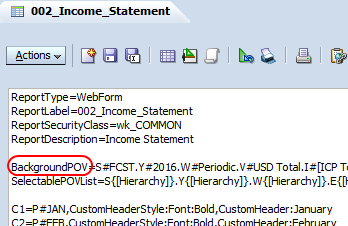
There is a graphical interface for designing and editing forms.  This gives a friendly way of representing the script that is used to define the dimensions, members, and format of the form.  From the editor there is a button on the Actions bar that lets you edit the script directly.


Notice the line that starts with BackgroundPOV=.  This defines the default POV for the form.  So while one option is to use the GUI tools to update the POV, it is often quicker to edit the script and save the update.


Because the form is defined in a script, the script is what gets saved when we do LCM exports.  The relative path is ..\resource\Forms\Web Forms\.  Beneath that are the folders and forms as defined in workspace.  Each form is saved in an .xml file, but the content of the .xml file is primarily the script that we see in workspace.


Our strategy is to export the forms, edit the .xml files to update the year in the BackgroundPOV, then use LCM import the updated forms.

Solution

The key is generating a script to automate the change.  Powershell makes it easy to traverse a folder and subfolders for documents.  In this case the filter is easy because the forms all reside beneath a single parent folder and are all defined in .xml files.

We open each file in turn and look for the BackgroundPOV line.  The POV is defined using the standard HFM scripting style of <dimension>#<value> with periods separating the dimension definitions.  So we search for the string .Y# then use a simple substring to find the year value and replace it with the new value.

The sample script is:

# PoSh script to update POV in the web forms in HFM application with the new year
#    We use the LCM export of the forms for the application.  The exports include the
#    report script in the .xml files.  We search for the BackgroundPOV line and replace
#    the Y# value with the new year.
#
#    I'm assuming that the current year is correct and so we increment the year.
#    We could use a similar techinique and replace the year with a static value
#

# All of the folders that have the web data forms that have to be updated
[array]$Dirs = #Folder 1, `
            #Folder 2, `
               # ...      `
            #Last folder

foreach ($D in $Dirs) {

    # Get all of the .xml files in the current web form folder
    #
    $Files = Get-ChildItem -path $D -filter '*.xml'
 
    foreach ($FN in $Files) {
        $FN

        # Read and loop through the .xml file
        #
        $Script = Get-Content $FN.FullName
        for ($i=0; $i -le $Script.Length; $i++) {

            # Found the line we need to change
            #
            if ($Script[$i] -match 'BackgroundPOV') {
                $L = $Script[$i]

                # Get the 4 digit year.  POV is standard nomencalture so search for .Y#
                #
                $Year = $L.Substring($L.IndexOf('.Y#')+3,4)

                # Increment the year.  Note we convert to integer then back to string
                #
                [string]$New = [int]$Year + 1

                # Replace the year in the script line
                #
                $Script[$i] = $L.Replace($Year,$New)

                # There is only one line per file so exit the for loop
                #
                $i = $Script.length
            }
        }

        # Overwrite the old file with the new
        #
        $Script | out-file $FN.FullName
    }
}

Here are some things to note about the script.  I force the list of folders into an array even if I need just one folder; this gives the script flexibility to use any number of folders.  I hard code the path for the forms but that could be replaced with a prompt or command line parameter.  I assume that the current year in the form is correct and increment the value, but you can replace that with a static string if you need to updated forms with a specific value.  Also, I did not use the -Recurse option in the Get-ChildItem commandlet, but this can be used to traverse all subfolders in the -Path to process all of the .xml files in all directories.  And it is good to have a backup, so before you run the script either do two LCM exports or work from a copy so you can return to a known good state if things go belly up.

I assume you know how to export and import using LCM so I don't describe that process.  My goal is detailing the strategy for doing the mass update and showing the sample script that you can customize for your needs.  The text files generated by LCM lend themselves to scripting techniques like this if you have similar issues with other products.  And while I'm personally a fan of PowerShell for scripted solutions, there are other scripting tools available if your comforts lie elsewhere.